Is Carrollton's Tap Water Safe?
Carrollton's public water is treated, tested, and monitored to meet public drinking-water standards, but the water system can't ensure perfectly clean water at every individual tap.
Home filtration provides an additional layer of treatment for homeowners who want more control over the water they use every day.
What's This Mean?
Much of Carrollton's public water is supplied through Isle of Wight County's Northern Development Service District, which purchases its water rather than relying solely on local wells. Virginia identifies the system as a purchased surface-water system.
The regional water network serving Isle of Wight is connected to the Western Tidewater Water Authority, which receives raw water supplied by the City of Norfolk's extensive regional water system. Norfolk's supply includes reservoirs in Suffolk and Isle of Wight as well as water from the Blackwater and Nottoway Rivers.
After treatment, that water still has a journey to make. It travels through the regional and county distribution systems, your service line, and finally the plumbing inside your home before reaching your faucet.
The public water system can treat and monitor the water it supplies, but it can't control every condition the water encounters on the way to each individual tap.
That's where whole-home filtration comes in. It provides a final layer of treatment at your home, giving your family more control over the water you drink, cook with, shower in, and use every day.
Why Is Chlorine Added To Carrollton's Water?
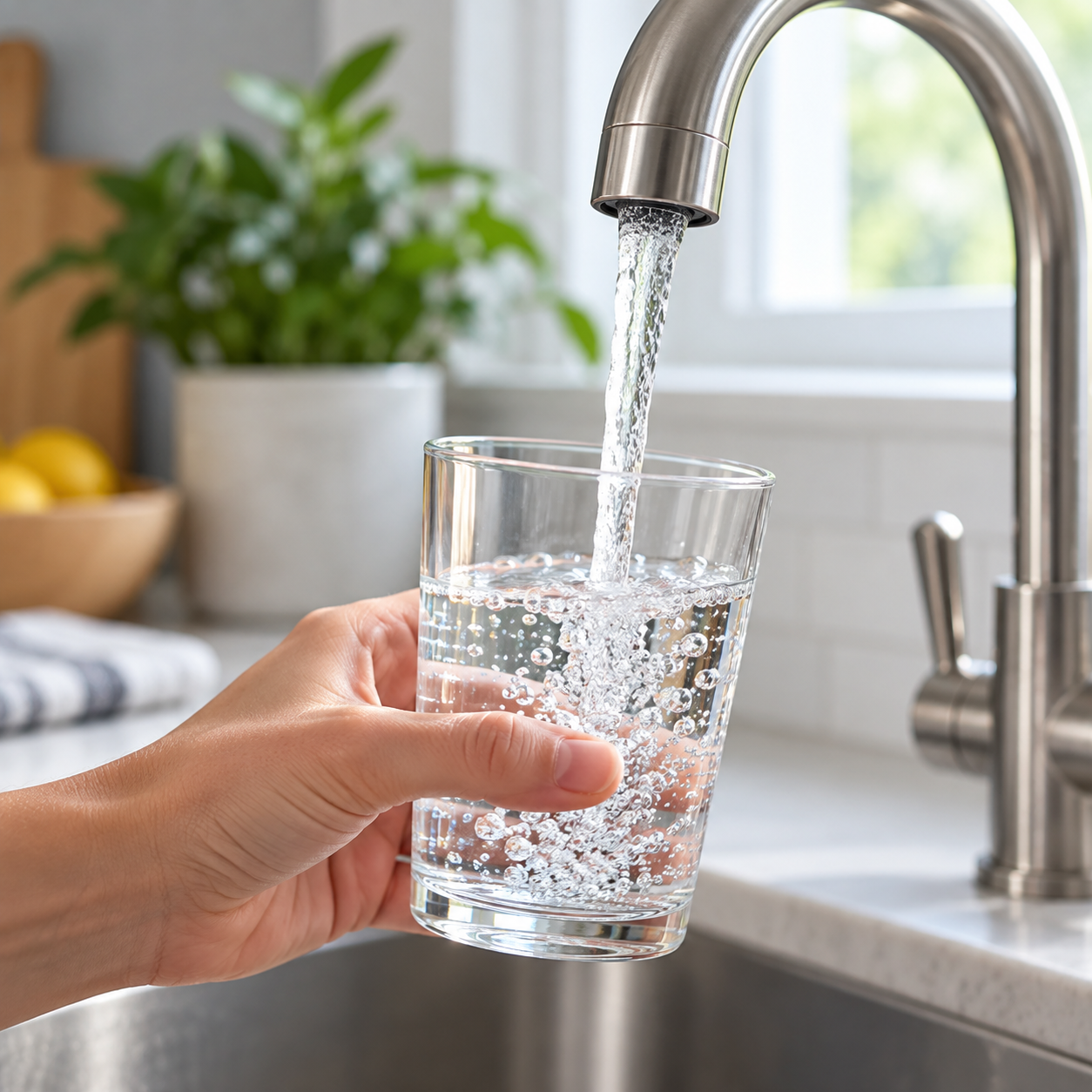
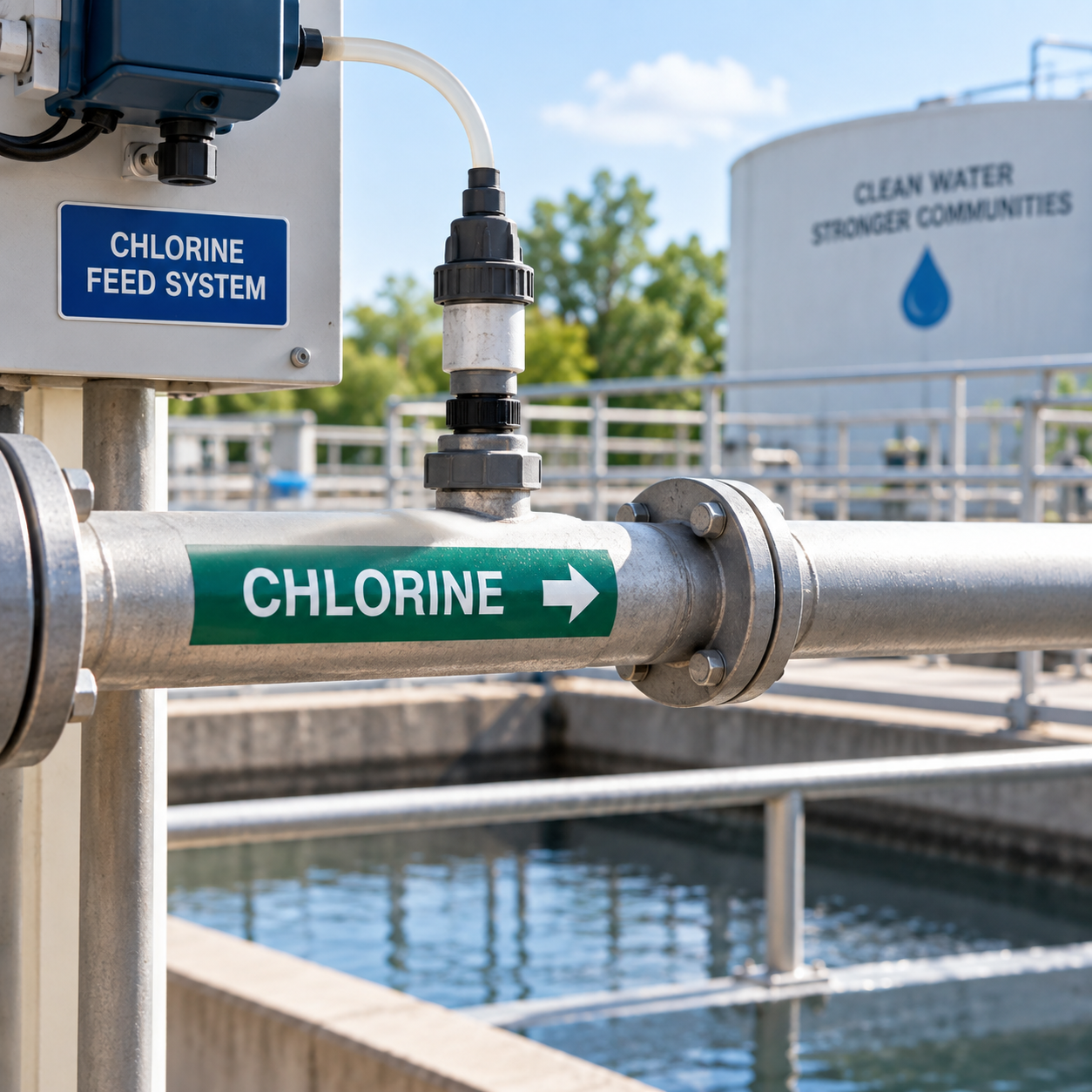
Chlorine helps keep Carrollton’s water disinfected as it travels from the treatment plant to your home.
It serves an important purpose in a public water system—but the chlorine doesn’t disappear when the water reaches your house.
What's This Mean?
When we say chlorine, Carrollton’s water is more specifically disinfected using chloramine—a combination of chlorine and ammonia. Chloramine is commonly used in regional water systems because it remains effective longer as water travels through miles of distribution piping.
That disinfectant serves an important purpose while the water is traveling through the public system. But once the water reaches your house, that journey is essentially over.
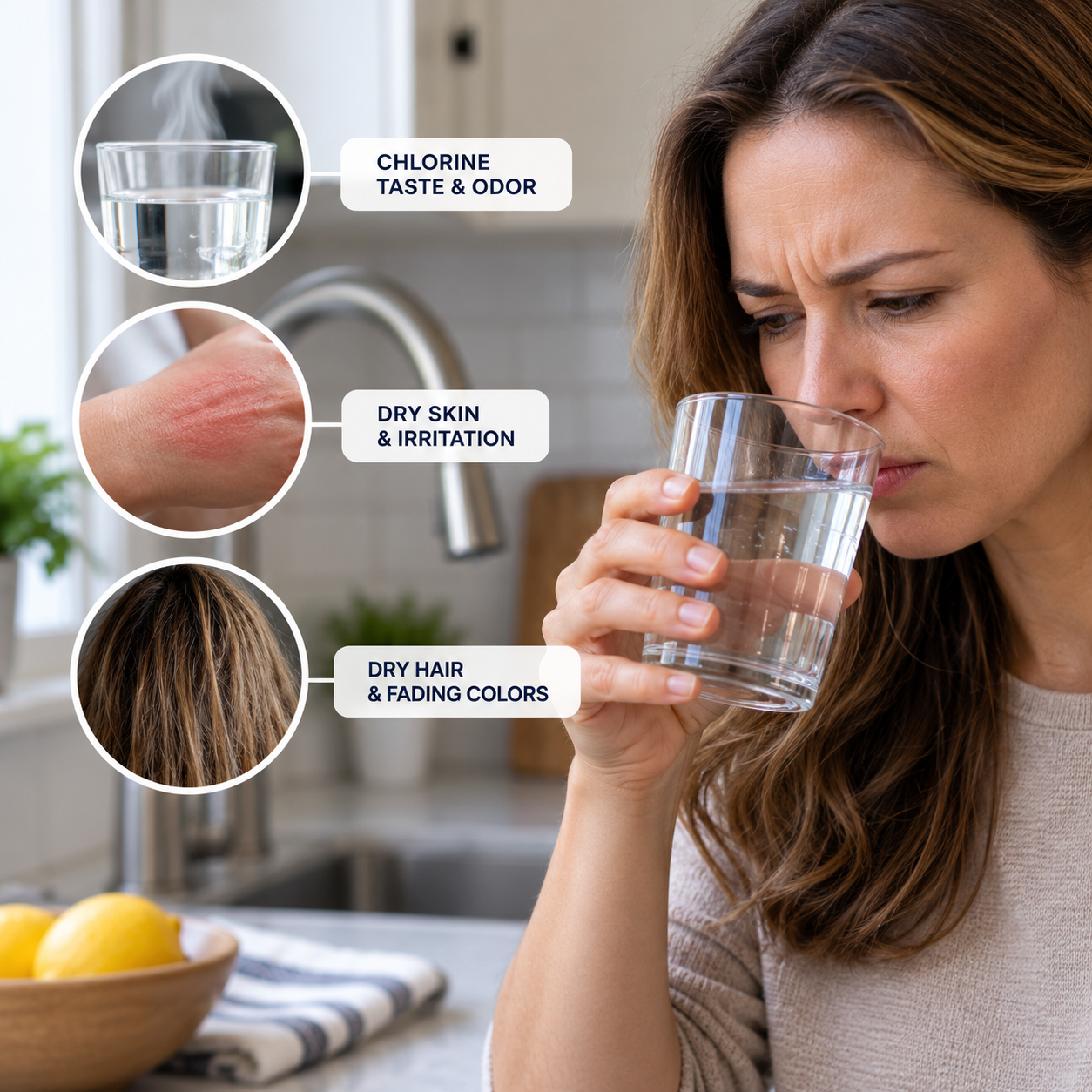
Without additional filtration, the remaining chloramine comes through the faucets and fixtures your family uses for drinking, cooking, showering and bathing.
Whole-home filtration gives homeowners the opportunity to reduce chloramine at that point—after it has helped protect the water during distribution, but before the water is used by their family.
Concerns With Chlorine In Drinking Water
As chlorine disinfects drinking water, it can react with naturally occurring organic material and create disinfection byproducts.
Two of the most closely monitored groups are Total Trihalomethanes (TTHMs) and Haloacetic Acids (HAA5).
What's This Mean?
Disinfection byproducts aren't chlorine or chloramine themselves. They are new chemical compounds formed when disinfectants react with naturally occurring material in water. Two major groups found in treated drinking water are trihalomethanes (TTHMs) and haloacetic acids (HAA5).
These compounds are taken seriously by public-health agencies. The EPA regulates both groups because long-term exposure above its limits is associated with health concerns. EPA identifies increased cancer risk for both HAA5 and TTHMs, and also lists potential liver, kidney and central nervous system effects for TTHMs.
The National Cancer Institute says research on disinfection byproducts helped lead EPA to lower allowable levels of TTHMs and HAA5, and epidemiological research has repeatedly found an association between long-term exposure to trihalomethanes and bladder cancer risk.
Chloramine is used in Carrollton's regional water supply because it provides longer-lasting disinfection as water travels through the distribution system. Like other disinfectants, however, chloramine can contribute to the formation of disinfection byproducts.
The important question for a Carrollton homeowner is therefore not simply whether these compounds are regulated—but how much is actually being measured in Carrollton's water.
What Does Water Testing Show In Carrollton?
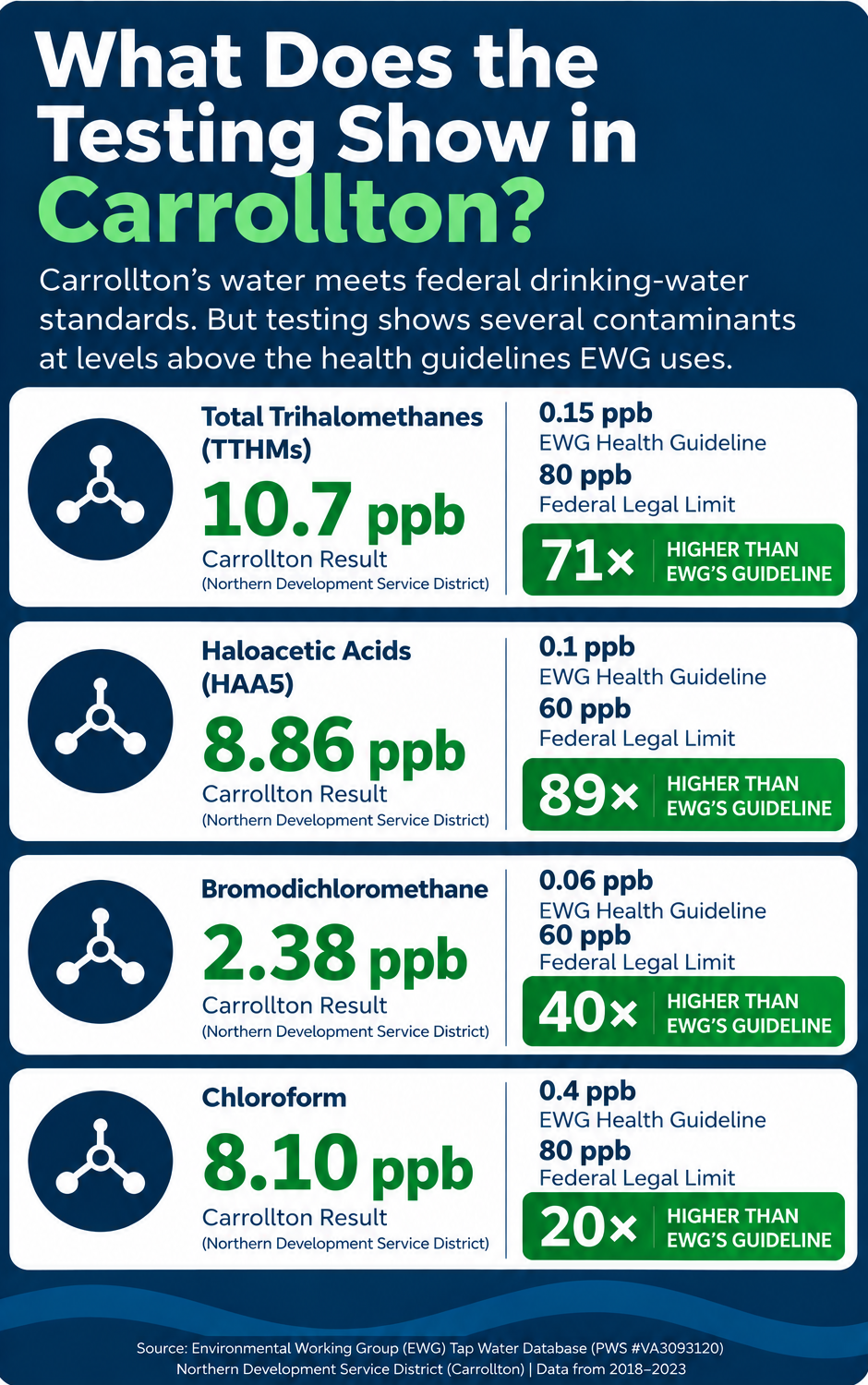
Carrollton's water meets federal drinking-water standards.
But EWG's analysis of state testing data shows several contaminants at levels above the health guidelines EWG uses, including disinfection byproducts known carcinogens.
What's This Mean?
The Environmental Working Group (EWG) is a national nonprofit that analyzes drinking-water testing data reported by utilities and state agencies. Its Tap Water Database compares those results with federal legal limits and with EWG's much lower health-based guidelines. For Carrollton's Northern Development Service District, EWG analyzed utility testing data from 2018–2023 and reports six contaminants above its health guidelines, although the water system was in compliance with federal drinking-water standards during the latest EPA period assessed.
What stands out in Carrollton is that the contaminants exceeding EWG's guidelines are disinfection byproducts. These aren't contaminants being pumped into the water at the treatment plant. They can form when chlorine, chloramine or other disinfectants used to protect drinking water react with naturally occurring organic material in the source water. EPA regulates disinfection byproducts because long-term exposure above federal limits can present health concerns.
Total trihalomethanes (TTHMs) are a family of four disinfection byproducts. Carrollton's water measured 10.7 ppb, compared with EWG's health guideline of 0.15 ppb — about 71 times higher. The federal legal limit for TTHMs is 80 ppb. EPA lists potential liver, kidney and central nervous system effects, as well as increased cancer risk, from long-term exposure above its federal limit.
Haloacetic acids (HAA5) are another group of disinfection byproducts. Carrollton measured 8.86 ppb, compared with EWG's guideline of 0.1 ppb — about 89 times higher. The federal limit is 60 ppb. EPA identifies increased cancer risk as a potential effect of long-term exposure above that limit.
Bromodichloromethane and chloroform aren't separate from the TTHM story—they're two of the four chemicals that make up TTHMs. Carrollton measured bromodichloromethane at 2.38 ppb, 40 times EWG's 0.06 ppb guideline, and chloroform at 8.10 ppb, about 20 times EWG's 0.4 ppb guideline. EPA identifies both as compounds that can form during drinking-water disinfection.
So the report doesn't say Carrollton's water violates federal standards. It shows something more nuanced: the public system is meeting its regulatory requirements, while measurable disinfection byproducts remain in the finished water at levels substantially above EWG's more conservative health-based benchmarks. For homeowners, that provides context for deciding whether they want an additional layer of filtration at the house to reduce these compounds before the water is used for drinking, cooking, bathing and other everyday uses.
Does Carrollton Have Hard Water?
Carrollton’s municipal water is generally considered soft.
That matters because many water-treatment packages automatically include a traditional salt-based water softener—even when the home’s actual water hardness may not justify one.
What's This Mean?
A water softener can be extremely useful when the water is actually hard. But installing one where it isn’t needed can create unnecessary tradeoffs.
Traditional softeners exchange hardness minerals such as calcium and magnesium for sodium. This adds sodium to the treated water and, depending on the water chemistry and plumbing materials, overly softened water can increase corrosion concerns for plumbing components and water heaters. It also means unnecessary salt use, regeneration water, and maintenance.
Many national water-treatment companies build their sales process around a standard softener package, rather than designing the system around the water conditions in each local market.
We take a different approach. We perform a hardness test at every home before recommending a system. If your water is hard enough to benefit from a softener, we’ll recommend one. If it isn’t, we won’t sell you equipment you don’t need.
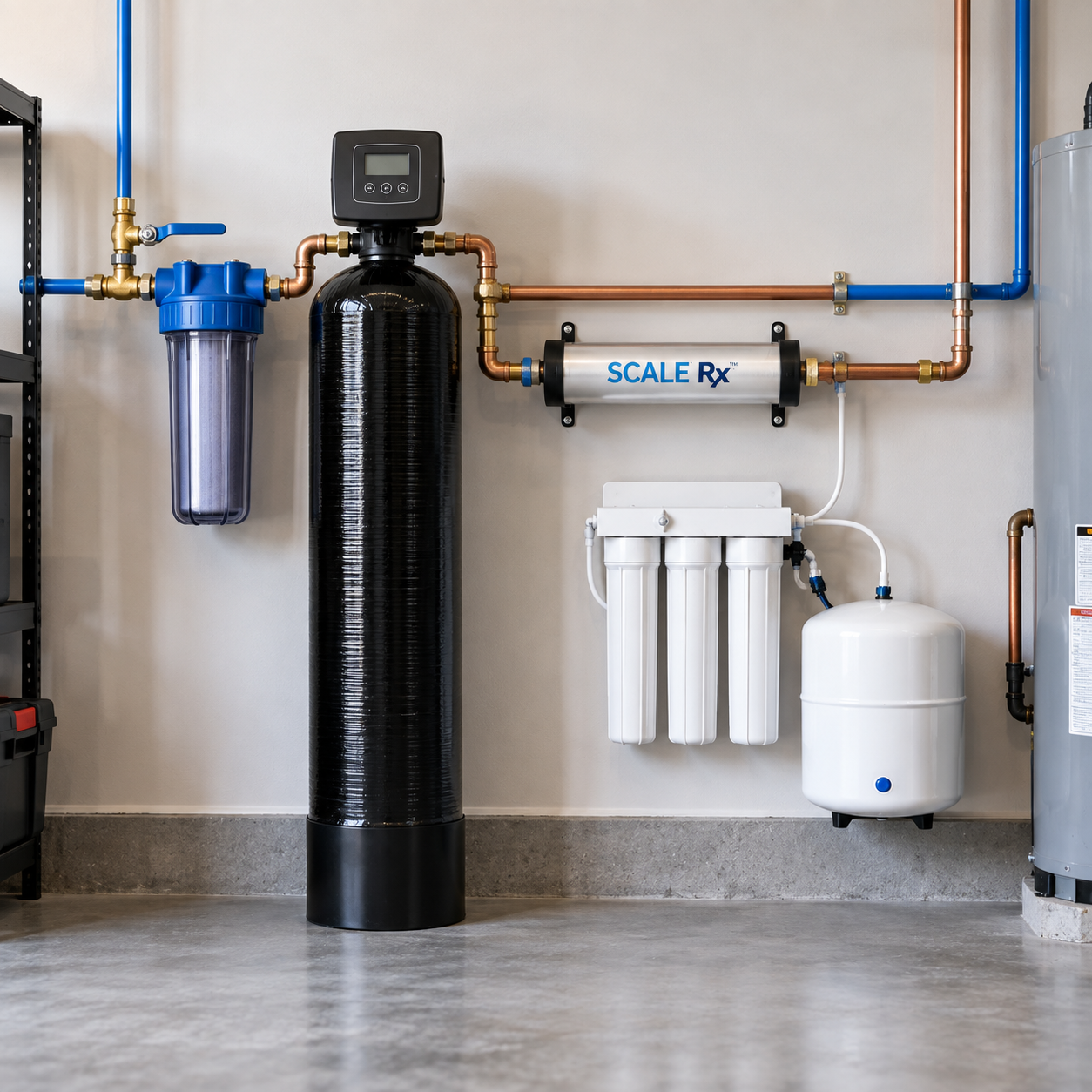
What's the typical Carrollton Water Setup?
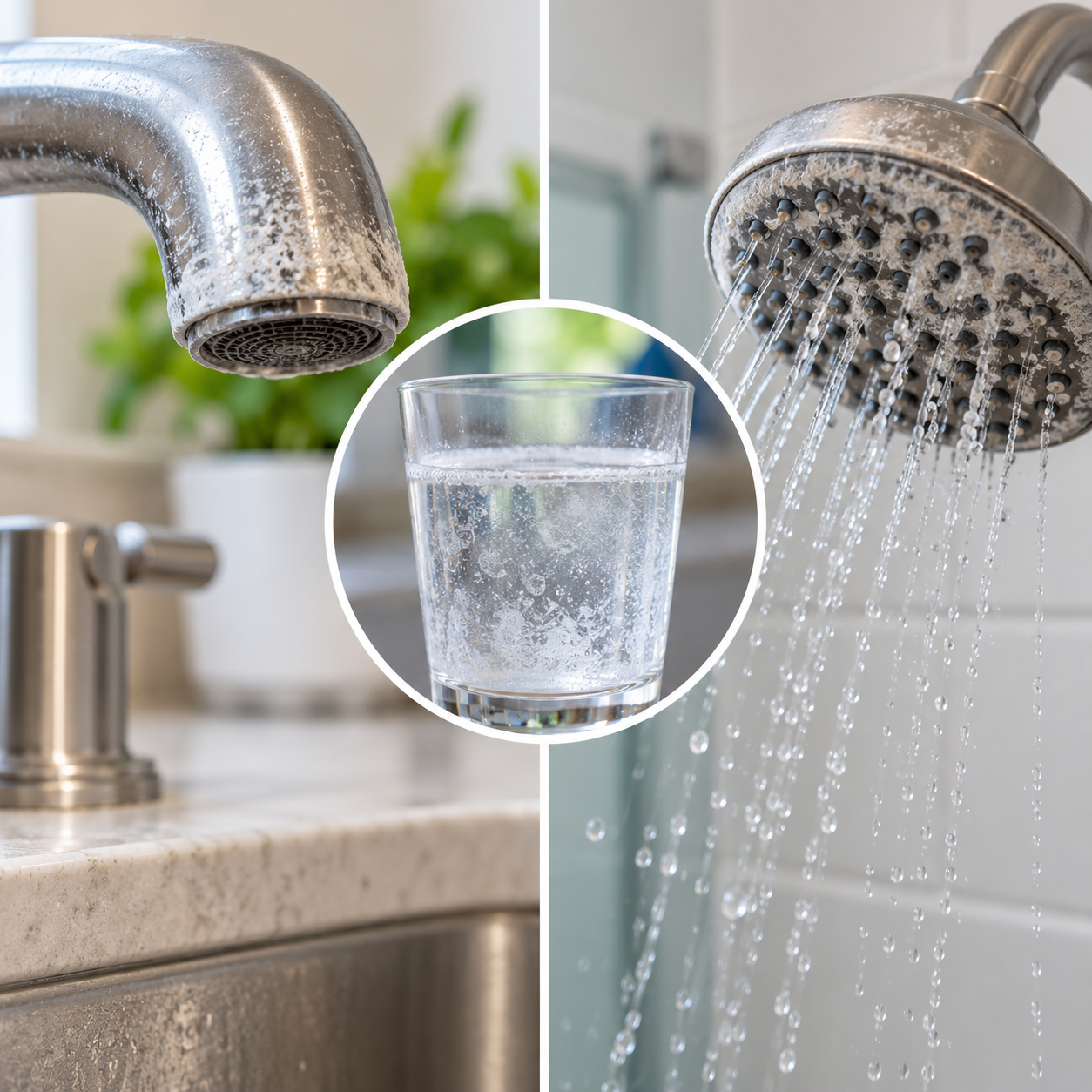
Because Carrollton’s municipal water is relatively soft, most homes don’t need a traditional water softener.
A typical setup focuses instead on whole-home filtration, scale protection, and highly filtered drinking water.
What's This Mean?
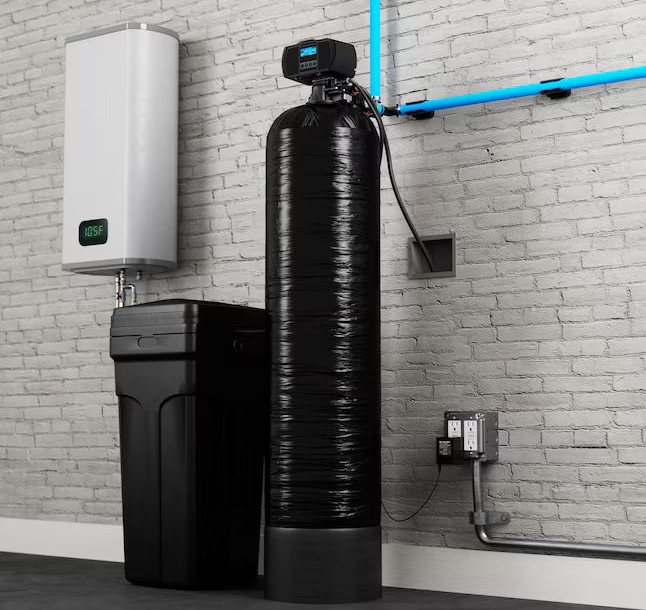
For many Carrollton homes, we recommend a whole-home carbon filtration system to reduce chlorine and other contaminants throughout the home, ScaleRx to help control scale without unnecessarily softening the water, and a reverse-osmosis drinking-water system for highly filtered water your family drinks and cooks with.
Every home is different, which is why we test the water—including hardness—before recommending equipment. The goal isn’t to install the most equipment. It’s to install the right equipment for the water you actually have.
Why Choose Patriot Water Systems?
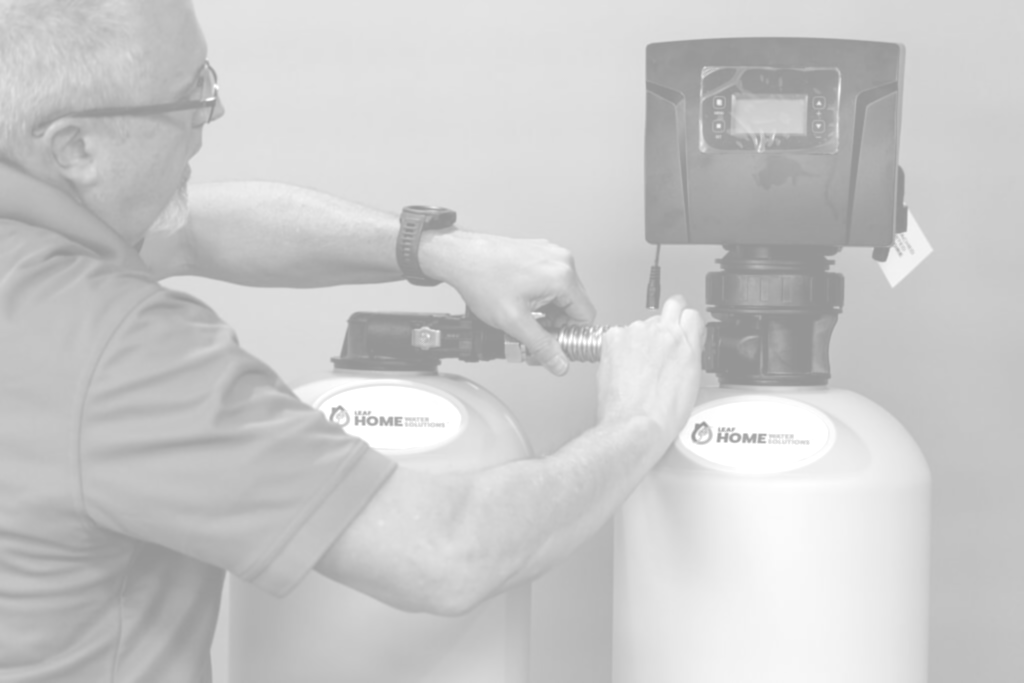
We live right down the road in Carrollton and know the local water. Every system is professionally designed and installed by our owner, a licensed Master Plumber and Virginia Class A Contractor.
You’ll receive honest recommendations, straightforward pricing, and a no-pressure consultation focused on what actually makes sense for your home.




Read Our
Client Reviews